
steal this agentic content engine
others are charging $2000/month for this. here's how to make it (better).


Hey,
so last week I took a look at a few of the main “AI content team” tools. Agents that plan, write, illustrate, publish and refresh a blog for you, end to end. The prices range from a few hundred a month, to thousands, which is insane. And then agencies charge even more.
The funny thing is I run a version of this system myself - with results on traffic growth shown below - and my API bill for the entire engine comes out to about $11 each month.
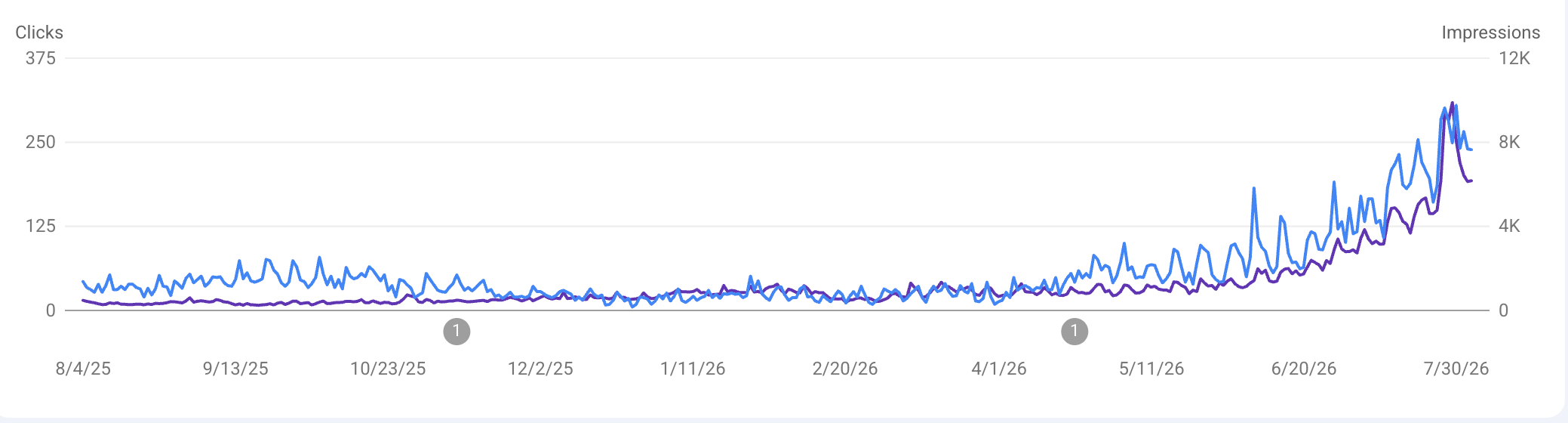
So today you get the whole org chart. And this issue has a twist: the email itself is the spec. Copy everything from here down into Claude Code, Cursor or Codex, say “build this,” and it will scaffold the entire engine.
What $2,000 a month actually buys
Strip the dashboard off any of these tools and the same machine is underneath: a topic queue, a handful of model calls with different system prompts, an image API, a publish step, and a cron (the automation) job. The features on the pricing page (”content refresh,” “AI visibility optimization,” “workflow automation”) are the agents below, renamed.
You’re not paying $2,000 a month for AI. You’re paying $1,989 for the dashboard.
If you’re building along: paste this whole email into your AI coding tool with the message “Build this system exactly as specified. Ask me for API keys and my blog details, then scaffold it.” Everything an agent needs is in the next three sections.
The six hires; the Robots on Payroll.
Each agent is a file containing a role prompt, called by one pipeline script. Model choice matters: 90% of your tokens go through the writers, so writers run on the cheapest capable model, and the editor runs on a frontier model because judgment is the one thing worth paying up for.
1. The Editor (frontier model, e.g. Claude Opus, or if you’re feeling extra confident, Fable it!). This agent owns quality.
You are the editor of [BLOG]. You receive a draft and the voice guide
(voice.md). You do not rewrite drafts. You either APPROVE or REJECT.
A rejection must list every failure as: quoted passage, rule broken,
what a fix needs to achieve. Reject any draft that: breaks a voice
rule, makes an unsourced factual claim, buries the answer below the
fold, or could have been written without reading the brief. Max 3
revision rounds per draft; after that, kill the piece and log why.
Failure mode to guard: the editor drifting into co-writer. The moment it rewrites, your cheap writers stop improving and your voice averages toward the model’s default.
2. The Writers (cheap model, e.g. Claude Haiku, or Sonnet if you’re me). Brief comes in, draft out.
You are a staff writer for [BLOG]. Input: one brief from queue/
(topic, target reader, search intent, outline, sources). Output: a
complete post in markdown following voice.md. Every factual claim
cites a source from the brief. Answer the reader's question in the
first 150 words. If the brief is too thin to write from, return
NEEDS-RESEARCH with the missing pieces listed. Never pad.
Why cheap models are fine here: the editor gate catches quality misses, and a rejected $0.09 draft costs less than the tokens a frontier model spends clearing its throat. Drafting 30 posts on Haiku: $2.70 a month. The same volume on GPT-5-nano is 17 cents, if you want to find out what the floor tastes like.
3. The Image agent (image API). One persistent style block, one hero per post.
You generate one hero image per approved post. Read style.md (palette,
composition rules, what is banned) and the post's title and first
paragraph. Write one image prompt that depicts the post's core idea
as a concrete scene, never text-on-image, then call the image API.
Save to /images/[slug]-hero.png. Same style block every time: the
archive should look like one artist made it.
Nano Banana Pro runs $0.134 per 2K image. OpenAI’s gpt-image-2 lands around $0.05 to $0.21 depending on quality tier. Thirty heroes images: about $4. (Feel free to edit this prompt, or append more stylistic features to ensure consistent images in your own style. You can also use screenshots of styles you like to copy it)
4. The Publisher (mostly code, minimal model). Takes approved posts, builds, ships.
On approval: insert frontmatter (title, description, date, slug),
commit to the site repo, trigger the deploy, verify the page returns
200 with content in raw HTML, update sitemap lastmod, ping IndexNow.
Schedule releases to publish-queue cadence (default: 1/day, never
batch-dump). Log every URL shipped to published.log.
The 200-check and HTML check matter: an engine that silently ships broken pages is worse than no engine (readers of the GEO issue will recognize the IndexNow ping).
5. The Backlinker. The quietly valuable one nobody builds.
Weekly: read published.log and the full archive. For each new post,
find the 3 old posts most relevant to it and add one natural
contextual link in each, anchor text descriptive, never "click here."
For each new post, add 2-3 outbound links to its sources. Never more
than one new link per paragraph. Output a diff for the editor to
approve before committing.
Internal links are how archives compound instead of pile up, and it’s exactly the kind of tedious, judgment-light work models are perfect for.
6. The Rankings agent (Google Search Console API, free). The one that makes the engine self-improving (this is key!!).
Weekly: pull 90 days of query + page data from the GSC API. Apply
three rules. (1) Impressions rising, CTR under 2%: file a title/meta
rewrite job. (2) Average position 5-15: file a refresh job (add depth,
answer adjacent queries). (3) Clicks down 30%+ vs prior period: file
a full rewrite job. File all jobs into queue/ as briefs with the data
attached. Touch nothing directly; every fix flows through writers and
editor like new content.
This is the agent the $2,000 tools sell hardest, usually as “content refresh” or “decay detection.” The API behind it costs nothing and the quotas (1,200 queries a minute) are roughly 1,000x more than a 30-post blog needs. Position 5-15 pages are the cheapest wins in SEO: the ranking work is mostly done and one refresh often jumps them to page-one clicks.
The wiring: two crons and a queue
content-engine/
  pipeline.py          # or .ts: the only orchestration file
  agents/              # the six role prompts above, one .md each
  voice.md             # your voice rules: the editor's law
  style.md             # image style block
  queue/               # briefs in, one .md per job
  drafts/              # writer output awaiting the editor
  published.log
  images/
Flow: queue/ → writers (parallel) → editor loop (max 3 rounds) → image agent → publisher → backlinker (weekly). The rankings agent runs on its own weekly cron and writes back into queue/, which closes the loop: content goes out, ranking data comes back, the archive gets stronger without you touching it.
Two crons. Daily: process the queue. Weekly: backlinker + rankings pass. That’s the whole company.
Don’t build all six on day one. Ship editor + one writer + publisher first (that’s a working blog), add the image agent when the text pipeline holds, and bolt on the backlinker and rankings agent once you have an archive worth compounding. Each addition is an evening.
When the build gets stuck (it will)
Your coding tool will loop on something while building this. Everyone’s does. The escape hatch, in order:
Call the loop at two. Same fix attempted twice means the model’s theory of the bug is wrong. More attempts buy you nothing.
Reset context. Fresh session, paste the spec section again. Loops live in polluted context.
Make it explain before it touches code. “Describe what’s failing and why, in three sentences, no code.” Wrong explanation means you found the actual bug.
Bisect. Comment out half the pipeline, run, repeat. Six agents means at most three cuts to isolate the failure.
Switch models last. A different model with the same polluted context usually finds the same ditch.
The full version of this playbook, with the prompts, lives in the Debug Loop kit.
The math: $11 a month, receipts shown
Thirty posts a month, verified prices, arithmetic shown:
Writers (Haiku, $1 in / $5 out per million tokens, ~50k in + 8k out per post): $0.09 a post, $2.70 a month
Editor (Opus, $5 / $25, ~20k in + 2k out per post across review rounds): $0.15 a post, $4.50 a month
Images (Nano Banana Pro, $0.134 each): $4.02 a month
Publisher, backlinker, rankings agent: rounding error, and the GSC API is free
Total: about $11 a month. Budget $30 to be safe with retries, longer contexts and refresh jobs, and the batch APIs cut whatever you spend in half if you let jobs run overnight. Against $2,000 a month you’re at roughly half a percent of the price, and the gap isn’t the AI. It’s the dashboard, the sales team, and the margin.
Worth it / not worth it
Paying $2,000 is rational in exactly three cases: you’re a funded startup where an FTE-shaped invoice is easier than an engineering ticket, you’re an agency reselling the output at markup, or your time is genuinely worth more than the weekend this takes. Not worth it if you’re an indie builder: content is your moat, and renting your moat at 180x the parts cost is how moats end up owned by someone else’s SaaS.
The production-grade version of this system (worktree isolation, orchestration prompts, review gates for running many agents without chaos) is the Agent Team Playbook in the Vault.
Seen this week
Sonnet’s intro API pricing dies Aug 31. $2 in / $10 out becomes $3 / $15 on Sept 1. If Sonnet is your writer tier, your engine gets 50% pricier in four weeks; on Haiku you won’t notice. Worth re-running your own math before the boundary.
The head of Claude Code has spent 2+ weeks trying to get an agent to rewrite the Claude desktop app in Swift. Still not done. If the guy who built the tool hits walls on a big vague goal, the lesson isn’t “agents are overrated.” It’s that tight specs win, which is why today’s issue is one.
Gwern is retiring from full-time writing to build an agent. The internet’s most prolific essayist announced this week he’s stepping back to launch Guardian Angel, a personal LLM that emulates your personality, values and preferences and acts for you. When the best human writer on the internet decides the leverage is in the engine, not the essays, that’s worth sitting with.
Vibe coding tip of the week
Steal the editor’s core mechanic for any agent work: reject, don’t rewrite. When output misses, resist fixing it by hand. Reply: “Rejected. Here’s the quoted passage, the rule it breaks, and what a fix must achieve. Revise.” Hand-fixing trains nothing; rejection with reasons makes round two dramatically better, and it’s the difference between managing agents and babysitting them.
Deal of the week
Still building the deals desk. When there’s a discount here, it’ll be one we negotiated and would take ourselves; if a vendor wants this slot, replies to this email reach me.
What we liked from around the web
I cut my Claude API costs from $70/month to pennies: HN thread on batch APIs, model downgrades and terse outputs. The poster finding Haiku “performed better at a third of the cost” is the writers-tier argument in one line.
How we built an automated AI blog in one afternoon: Claude Code plus GitHub Actions cron plus Vercel, reported running cost $10-20 a month. Independent confirmation of today’s math.
A full research-to-publish pipeline at $1.50 an article: a different wiring of the same six jobs, with the cost receipts.
15 agents on a $100 Claude Max sub, overnight: the same org chart as today’s issue, run on a flat subscription instead of API keys. Zero marginal cost per job is its own kind of math.
Atomic Vibe Coding: fresh essay arguing the bottleneck is intent precision, not the model. “Anything you leave unsaid, the model fills in with the most common answer from everything it has ever read” is the best one-line explanation of vibe coding failure I’ve seen.
agent-manager: a tmux TUI for running Claude Code, Codex and OpenCode fleets in parallel. If you end up loving your six-agent engine, this is what the cockpit looks like.
Bullshit Detector: agent skills that fact-check any video or article claim-by-claim and output a 0-10 score. Steal its verification pattern for your editor agent.
github.com/topics/blog-automation: open-source content pipelines to strip for parts before you build your own.
Thanks so much!
Jonathan